ClickHouse Loom documentation
Share memory across AI agents, search documents and link lessons to code. Find Loom setup, evaluation and deployment guides.
Loom stores memory, documents and code indexes in ClickHouse, with Postgres as an option for live memory and knowledge state. Connect through a coding-agent plugin, MCP, HTTP, the Python and TypeScript SDKs or the dashboard.
Start here
| Step | Read |
|---|---|
| 1. Decide | Overview → Evaluate Loom |
| 2. Install | Quickstart → Deployment |
| 3. Connect agents | Connect a coding agent → Integrations |
| 4. SDK and API | Your first agent → Python SDK / HTTP API |
| 5. Namespaces and access | Identities and namespaces → Tokens and grants |
| 6. Code index | Code index → Repositories → Code-index operations |
| 7. Operate | Monitoring · Troubleshooting · Upgrades · Backup and recovery |
Use cases
One page per need, each saying what Loom does for it and where to start: agent memory · document search and RAG · knowledge factory for AI agents · code index for coding agents · repository Q&A without a checkout · code index by language · memory linked to code · coding-agent model cost · shared memory for software factories · autonomous agents: recall, audit, erasure · runs, traces and PR history · self-hosted agent memory with SQL · all use cases.
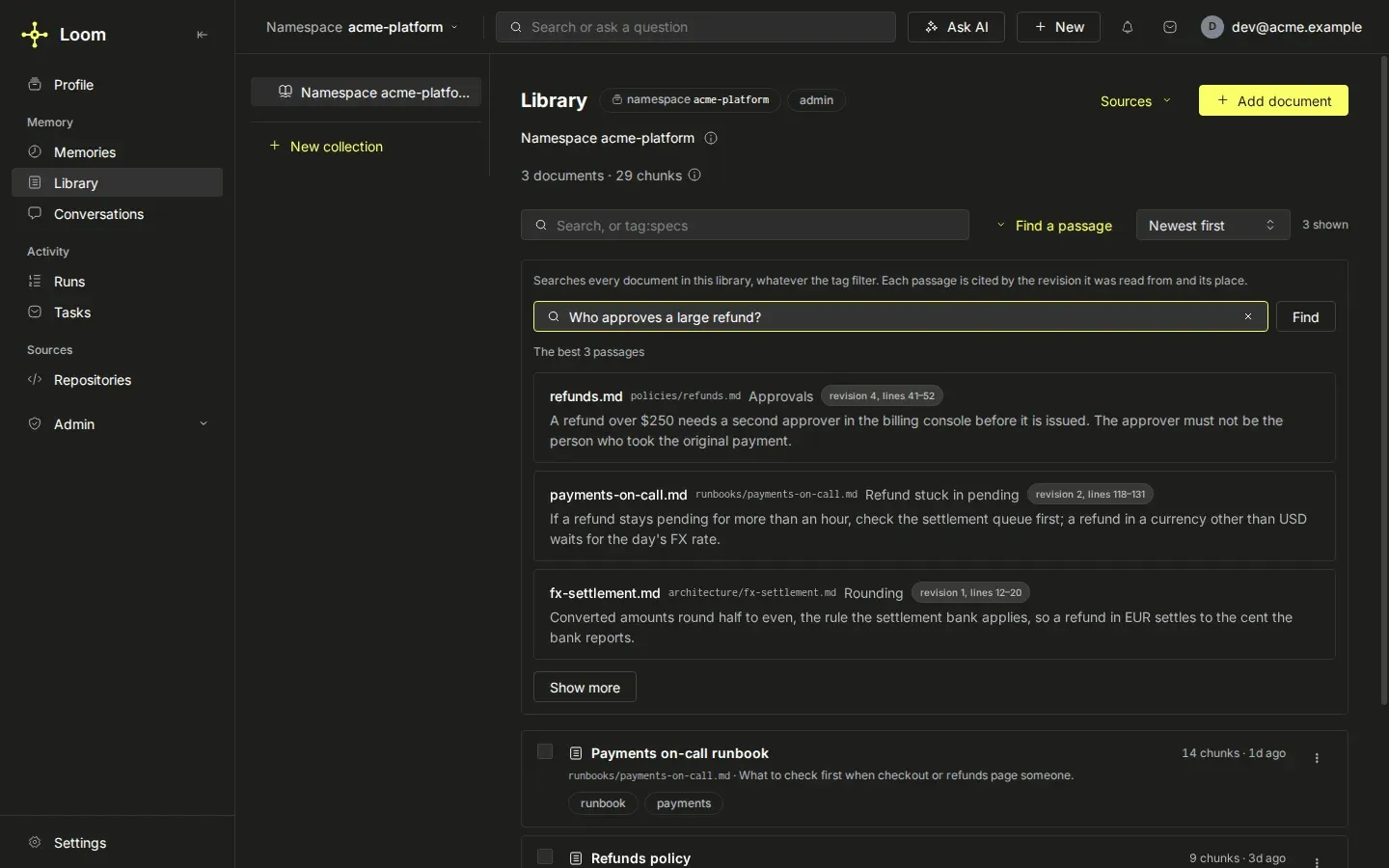
Watch the cited-answer demo
1. Getting started
- Overview: what Loom is, when it fits, prerequisites.
- What’s included: Loom’s main capabilities, each with its page.
- Quickstart: the local stack end to end.
- Configure models and API keys: agent subscriptions, server LLMs, embeddings and single-provider setups.
- Evaluate Loom: smoke test, workload evaluation and reproducible public benchmarks.
- Connect a coding agent: plugin or MCP entry.
- Set up Loom with your coding agent: for an agent that installs a pinned release and proves it works, with a fixed report.
- Your first agent: an SDK tutorial.
2. Install and run the server
- Deployment: shapes, environment, providers, identity modes, proxy, images, production checklist.
- Single sign-on: an OIDC identity provider for the dashboard,
loom loginand MCP clients. - Use Loom without the dashboard:
loom login,loom calland the SDK call for every dashboard view. - Upgrades · Supported versions · Backup and recovery · Monitoring · Maintenance · Runtime settings · Troubleshooting · Code-index operations · Running N replicas: identical Looms behind one URL · Postgres: the Postgres memory authority · Kubernetes: the Helm chart, with EKS and kind overlays · ClickHouse Cloud and Managed Postgres: the chart over both managed services · Copying a namespace to another Loom · Exporting usage to a data warehouse
3. Connect agents
Integrations · MCP clients · Agent instructions · Claude Code · Codex · Cursor · VS Code · Frameworks · Grep shim · Langfuse · ClickStack · OKF
4. SDK and API
Reference index · HTTP API · MCP · Python SDK · TypeScript SDK · Go SDK · Environment · Operations · Configuration · Workers · CLI · Errors · Status · Schema · Extractor contract. Operations and fields change between releases; unknown and removed fields says how a client sees one the server no longer reads.
5. Namespaces, access and the memory model
- Identities and namespaces: the tuple, roles, grants and read scope.
- Agentic memory: working memory, long-term recall, time, history, provenance.
- Retrieval and ranking: legs, fusion, abstain, calibration.
Guides
Agent integration · Headless bots · Tokens and grants · Trace and resume long runs · Choose AI software factory tools · Optimize a namespace · Investigation-agent memory · Extraction pipelines · Performance tuning · Debugging · Query Loom from Postgres · Teaching with Loom
Features
- Planes: namespaces and sharing · unified search · knowledge · entity graph · conversations and sessions · runs · tasks and decisions · dashboard
- Memory: writing · search and ask · conflicts and refusal · extraction · history and provenance · retention and erasure · procedures and learnings · working memory and profiles
- Observability: audit · cost and usage · telemetry
- Tracker: overview · record contract
6. Code index
Overview · Repositories · Freshness · History and PRs · Operations · Code-index operations runbook
Architecture
System overview · Server layout · ClickHouse · Memory architecture · Storage authority · Cells · Storage layout · Code-index architecture · Document extraction · Document sources · LLM and embeddings · Security · Assistant design · Failure and recovery · Rolling upgrades
Benchmarks
Overview · Coverage · Methodology · Running · Results · Adding a case · Skill eval
Development
For contributors: repository guide · local development · testing · code generation · migrations · release process · documentation style · curation loop design · extending Loom · add an operation · add a worker · add a table · add language support · dashboard design. CONTRIBUTING.md covers the pull-request workflow.
Also
Glossary: Loom’s terms, defined once. FAQ: the first questions, one
paragraph each. llms.txt: a generated index of the docs for agents;
llms-full.txt holds, in one file, the
pages that say what Loom is and how to start.